Fabrics & Materials
How to Choose the Right Fabric for Team Uniforms
A buyer-friendly guide to polyester interlock, mesh, pique and spandex blends — and how to match fabric to sport, climate and budget.
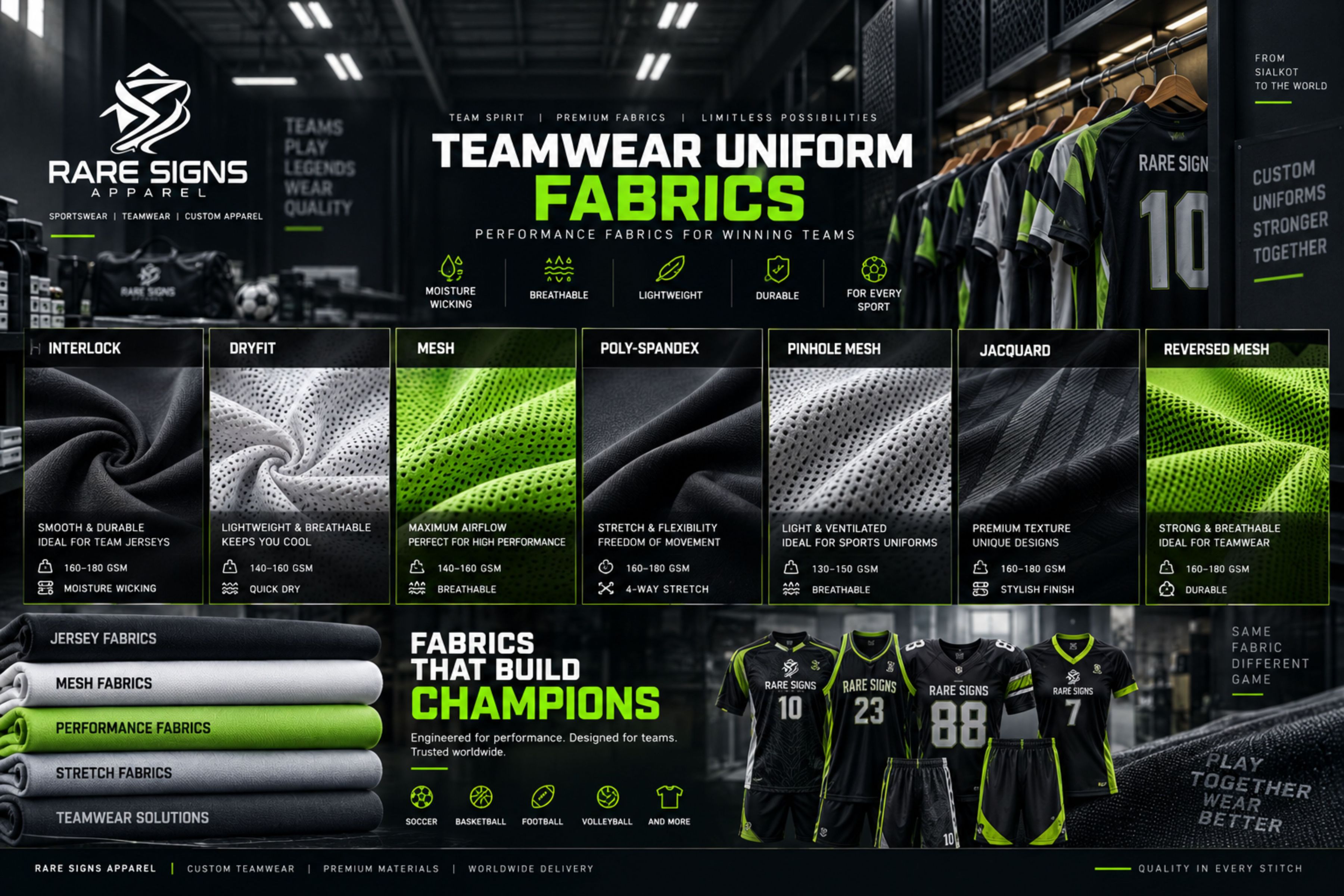
Fabric decides how a uniform performs on the field and how long it survives a season. Before you approve a sample, it helps to understand the four variables every mill works with: fibre, knit construction, weight (GSM) and finish.
Start with the sport, not the swatch
Contact sports need abrasion resistance and seam strength. Endurance sports need airflow and low water retention. Indoor sports need stretch recovery so garments keep their shape through repeated pivots.
- Football and rugby: 150-180 GSM polyester interlock, or a heavier 200 GSM knit for rugby shirts that take pulling loads.
- Basketball: 130-160 GSM micro mesh for airflow, with a bonded or double-stitched armhole.
- Training and running: 120-150 GSM birdseye or hex mesh with a moisture-wicking finish.
- Compression base layers: 200-240 GSM polyester-spandex (usually 82/18 or 88/12) for support without restriction.
Understand GSM before you compare prices
GSM (grams per square metre) is the single most common cause of quotation confusion. A 20 GSM difference changes the hand feel, opacity and cost per garment. When comparing two suppliers, always compare fabrics at the same GSM, the same fibre blend and the same finish — otherwise you are comparing two different products.
Climate matters as much as sport
Teams in humid regions benefit from open-structure mesh and a hydrophilic wicking finish that moves sweat outward quickly. In cold or variable climates, brushed-back poly fleece and bonded softshell keep athletes warm without adding bulk. If you supply distributors across multiple regions, consider a single silhouette produced in two fabric weights.
Colour, print method and fabric are one decision
Sublimation only bonds to polyester-rich fabrics, so full-colour graphic kits must be built on polyester. Cotton-rich fabrics take screen printing and embroidery beautifully but cannot hold sublimated all-over graphics. Decide the decoration method before locking fabric — not after.
What to ask your manufacturer
- 1.What is the exact fibre blend, GSM and knit construction?
- 2.Which wicking or anti-odour finish is applied, and how many washes is it rated for?
- 3.What is the colourfastness and shrinkage result after industrial laundering?
- 4.Can you supply a physical sample in the final fabric before bulk production?
At Rare Signs Apparel we keep validated fabric libraries for each category so buyers can compare hand feel side by side before committing to bulk. Browse the full product range or read about our customization services to see how fabric, fit and branding come together.
Ready to spec a kit? Request a quote with your sport, quantity and target price, and our export team will recommend two or three fabric options with samples.
- #Teamwear
- #Fabric
Planning a production run?
Share your styles, quantities and target market. Our export team replies with fabric options and a delivered price.


