Manufacturing
How to Choose a Sportswear Manufacturer: A Buyer's Checklist for 2026
A practical, factory-floor checklist for sports teams, clubs and wholesalers evaluating a custom sportswear manufacturer — from fabric sourcing and stitching standards to sampling, capacity and export documentation.
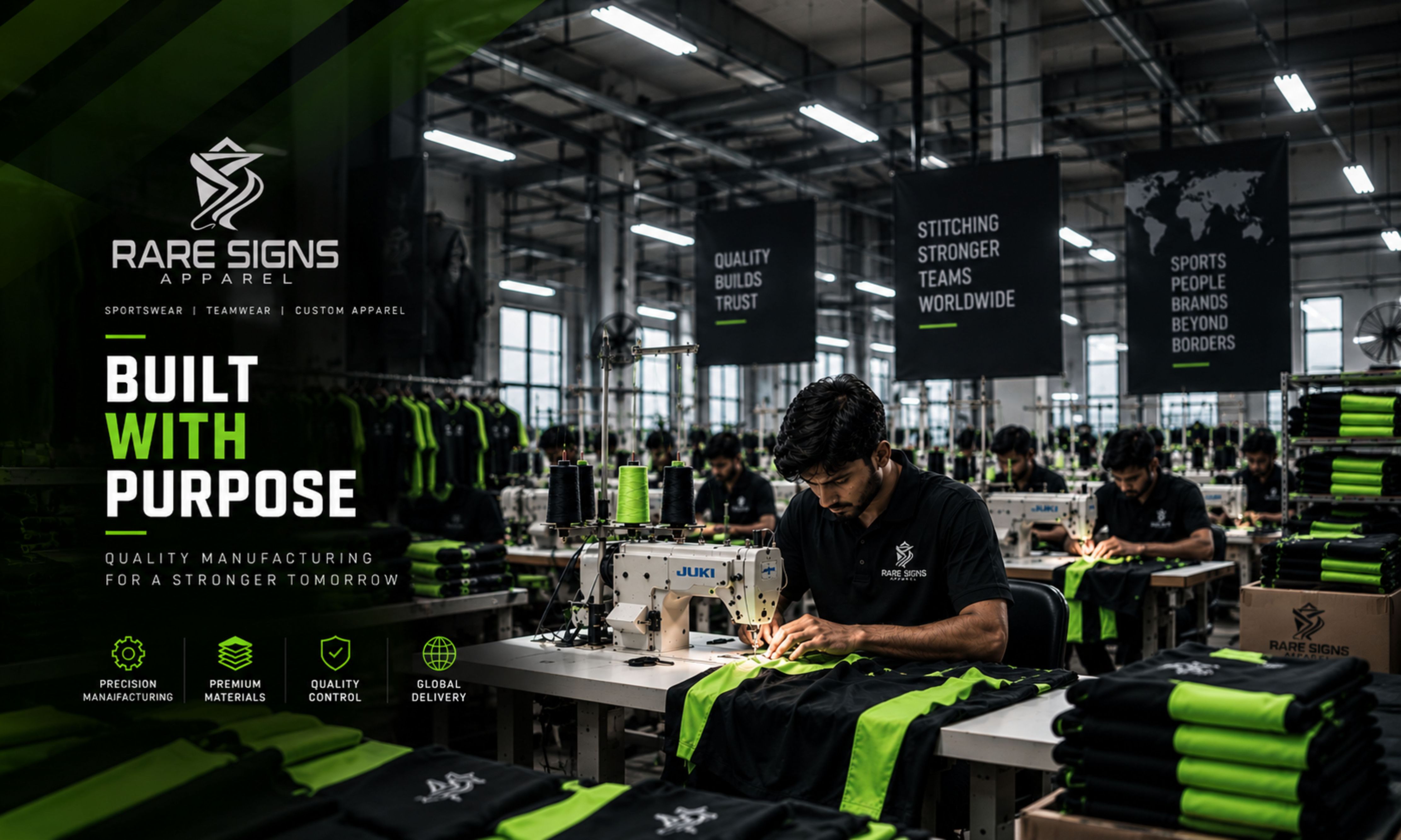
Why the manufacturer decision matters more than the price list
Custom sportswear is a technical product. The same jersey design can perform brilliantly or fail after ten washes depending on fabric GSM, dye chemistry, seam construction and quality control. For sports teams, clubs, resellers and wholesalers, the manufacturer you choose determines fit consistency across repeat orders, colour accuracy between seasons and whether your delivery lands before the season starts.
At Rare Signs Apparel we have manufactured and exported custom sportswear since 2017, and the buyers who get the best results all evaluate suppliers the same way. Here is that checklist.
1. Verify in-house manufacturing capability
Ask which processes happen under the supplier's own roof. A genuine manufacturer controls:
- Cutting and pattern making
- Sublimation printing, screen printing and embroidery
- Stitching lines with dedicated operators
- Quality inspection and packing
When printing or embroidery is subcontracted, lead times stretch and colour consistency drifts between batches.
2. Interrogate the fabrics, not just the photos
Request the fabric name, composition, GSM and finish for every style you are quoting. Performance sportswear typically uses:
- Interlock and micro polyester for sublimated jerseys and kits
- Pique for polos and corporate teamwear
- Four-way stretch spandex blends for compression and fitness wear
- Brushed fleece and French terry for tracksuits and hoodies
A supplier who can explain moisture management, colour fastness and shrinkage behaviour is a supplier who tests them.
3. Judge the sample, then judge the second sample
The first pre-production sample proves capability. The second, made after your revision notes, proves process. Look at seam allowance, flatlock finishing, neck-tape alignment, print registration on logos and how numbers sit on the back panel.
4. Confirm capacity and lead time in writing
Ask for monthly output, current line loading and a written production timeline. Rare Signs Apparel runs a 20,000 units per month capacity with a 50+ member team, which is what allows repeat club orders and wholesale programmes to ship on schedule rather than on hope.
5. Check customization depth
Genuine custom manufacturing should cover:
- Full-colour sublimation and all-over prints
- Embroidery, appliqué and heat-transfer branding
- Custom neck labels, hang tags, size labels and polybags
- Private-label and white-label programmes
6. Review export readiness
International buyers should confirm the supplier's experience with export documentation, carton marking, air and sea freight coordination and courier consolidation. Ask which markets they already ship to and how they handle customs paperwork.
7. Test the communication before you test the product
Response time during quotation is the most accurate preview of response time during production. A manufacturer who answers technical questions clearly on WhatsApp or email at the enquiry stage will do the same when a deadline is at risk.
Bringing it together
Score every shortlisted supplier on these seven points before comparing unit prices. The cheapest quotation is rarely the cheapest order once reworks, delays and inconsistent sizing are priced in.
Talk to our production team
Send us your tech pack, artwork or reference images and our team will respond with fabric recommendations, a construction plan and a realistic production timeline. Reach us on WhatsApp or through the enquiry form for a quotation on your next custom sportswear programme.
Planning a production run?
Share your styles, quantities and target market. Our export team replies with fabric options and a delivered price.


